Planning a solo trip doesn't have to be overwhelming. It really boils down to three things: figuring out where you want to go, creating a realistic budget, and then locking in the big stuff like flights and a place to stay.
Why a Solo Trip Is Your Next Great Adventure
Going on an adventure by yourself is so much more than just a vacation. It's a chance to get to know yourself better, push your boundaries, and build some serious confidence. I get it—the idea of planning everything alone can seem daunting at first, but if you break it down into smaller, manageable pieces, that anxiety quickly turns into pure, unadulterated excitement.
This guide is designed to be your roadmap. We'll skip the overwhelming fluff and focus on the practical steps that make for a smooth, rewarding journey. Think of it less as a chore and more as designing an experience that is 100% yours, with no compromises.
The Rise of the Independent Traveler
Traveling alone isn't some niche activity anymore; it's a full-blown movement. Recent studies show that a staggering 58% of travelers worldwide were planning to take at least one solo trip. That number is only going up as more people get a taste of the freedom and personal growth that comes with it. If you're curious, you can dig into more solo travel statistics to see just how big this trend has become.
Traveling solo doesn't always mean you're alone. You meet marvelous people along the way who you would never have met if you were traveling with anyone else. – Andrew McCarthy
This infographic really captures the fundamental steps for planning your adventure from start to finish.
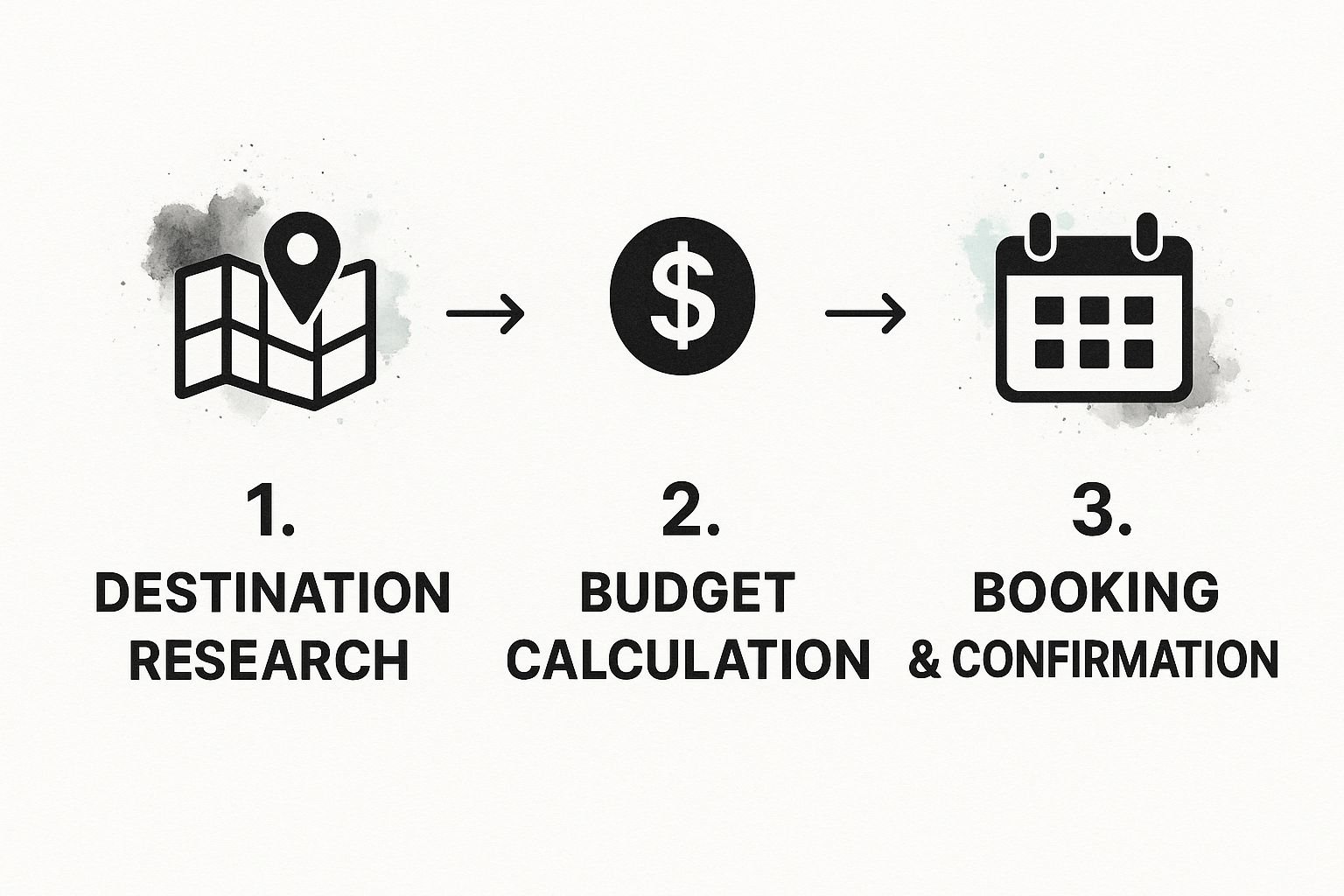
As you can see, every great solo trip is built on a foundation of solid research and smart financial planning before you ever book a thing.
To simplify the process, I like to think of solo trip planning in terms of these core pillars. Each one builds on the last, creating a solid foundation for your adventure.
Core Pillars of Solo Trip Planning
| Planning Pillar | Key Objective | Main Tasks |
|---|---|---|
| Destination & Research | Choose a location that fits your interests, budget, and comfort level. | Research safety, culture, visa rules, and must-see sights. |
| Budgeting & Finance | Create a realistic financial plan to avoid surprises. | Estimate costs for flights, lodging, food, and activities. |
| Logistics & Booking | Secure all major travel arrangements. | Book flights, accommodations, and any necessary ground transport. |
| Itinerary & Packing | Outline a flexible plan and prepare your gear. | Create a day-by-day guide (with room for spontaneity) and pack smart. |
Focusing on these key areas ensures you've covered all your bases, letting you relax and actually enjoy the experience you worked so hard to create.
What Makes Solo Travel So Empowering
The real magic of traveling by yourself is the absolute freedom. Every single decision—from what to eat for breakfast to whether you spend the day in a museum or hiking a trail—is yours and yours alone. That kind of autonomy is incredibly powerful.
Here’s what you really gain from it:
- Ultimate Flexibility: Feel like staying an extra day in a city you've fallen in love with? Go for it. Not feeling the vibe of a place? You can pack up and leave without a second thought.
- Deeper Connections: When you’re on your own, you're naturally more open to the world. You'll find yourself striking up conversations with locals and fellow travelers, leading to far more authentic experiences.
- Increased Self-Awareness: Without a travel buddy to fill the quiet moments, you get a lot of time to just think. It's amazing what you can learn about yourself when you're your only company.
- Real-World Problem-Solving: Missing a train or getting lost in a new city feels scary at first, but navigating those challenges on your own proves just how capable and resilient you truly are.
Finding Your Perfect Solo Destination
This is the fun part. Deciding where to go is the most personal and exhilarating step in planning your first solo adventure. Forget just picking a place off a "top 10" list—the real goal is to find a destination that genuinely clicks with you.
Are you picturing yourself wandering the vibrant, tiled streets of Lisbon? Maybe you’re dreaming of the lush, peaceful rainforests of Costa Rica or the ancient, serene temples of Kyoto. Whatever your vision is, your perfect spot is out there waiting.
The trick is to match a destination to your travel style, your comfort level, and what you’re hoping to get out of the experience. This isn't just about sticking a pin in a map; it's about designing an adventure that feels right from the get-go.
Aligning Destination With Your Travel Style
Before you get swept away by gorgeous Instagram photos, take a moment to think about the practical side of things. A mismatch between your personality and your destination is a recipe for unnecessary stress, and we want to avoid that.
Think through these factors to start narrowing down your options:
- What's your pace? Do you want a slow, meandering vibe where you can linger in cafes and wander without a strict agenda, like you might in a small Italian village? Or do you thrive in a high-energy city like Tokyo, with a world-class transit system that helps you see a ton in a short amount of time?
- How far out of your comfort zone are you ready to go? Navigating a country where you don’t speak the language can be an incredible growth experience. But for a first-timer, a place like Ireland or New Zealand, where English is widely spoken, might feel a lot more manageable.
- What are your passions? If you're a total foodie, a city like Paris or Mexico City is your playground. If history is your thing, Rome or Athens will feel like stepping into an open-air museum. For nature lovers, the jaw-dropping national parks in the U.S. or the otherworldly landscapes of Iceland could be the perfect escape.
It's interesting to note who is shaping the solo travel market. Women are absolutely dominating this space. Recent data shows that a staggering 84% of solo travelers identify as female. In fact, 54% of all women surveyed said they planned to travel alone in the next year, which has a huge impact on everything from tour design to safety features in accommodations.
Safety and Logistics for Solo Travelers
Let's be real: safety is the foundation of any good solo trip. When you feel secure, you can explore with confidence and truly be present. While no place is 100% risk-free, some destinations are consistently rated higher for solo traveler safety and are just plain easier to get around.
As you research, dig into these specific areas:
- Safety Ratings: Check out resources like the Global Peace Index or the travel advisories issued by your government. You're looking for places with low crime rates and a stable political climate.
- Transportation: How easy is it to get from A to B? Cities with fantastic public transit, like London or Singapore, make exploring on your own simple and affordable. On the other hand, a destination that pretty much requires a rental car might add a layer of complexity you’d rather not deal with on your first go.
- Solo-Friendly Infrastructure: Does the destination seem to welcome individual travelers? Places with a good network of hostels, single-room hotel options, walking tours, and cooking classes are often great choices. This kind of setup makes it much easier to meet other people if and when you want to.
A great solo trip destination isn't just about the sights; it's about how the place makes you feel. Look for locations known for their welcoming culture, where locals are friendly and helpful to tourists. This can make all the difference in your overall experience.
Ultimately, the best solo travel destinations are the ones that make you feel both excited and secure. Take your time with this step, do your homework, and trust your gut.
If you need a little inspiration to get the ideas flowing, you can check out our guide on the best solo travel destinations that are popular for their safety, activities, and welcoming vibe.
Budgeting for Your Trip Without Missing Out

Let's get one thing straight: a budget isn't a leash. It's your ticket to a stress-free solo adventure. Think of it less as a set of rules and more as a financial game plan that lets you enjoy every moment without that little voice in your head worrying about your bank balance.
When you know where your money is going, you can make decisions confidently. Should you spring for that Michelin-starred meal or put the cash towards a three-day trek through the mountains? A good budget makes those choices feel empowering, not agonizing.
The trick is to build a realistic framework that covers all your bases. Breaking down your spending into a few simple categories is the best way to get started. It’s a core part of planning a solo trip that feels both epic and financially smart.
Deconstructing Your Travel Costs
To get a real handle on what your trip will cost, you need to separate the big, fixed expenses from the day-to-day variables. This approach helps you see the complete financial picture upfront and avoid any nasty surprises later.
Here’s how I always break it down:
- The Big Three (Fixed Costs): These are the heavy hitters you’ll likely pay for in advance. We’re talking round-trip flights, all of your accommodations, and any major tours or activities you’ve pre-booked. These will form the foundation of your budget.
- Daily Spending (Variable Costs): This is for everything else that happens on the ground. Think food, from market snacks to nice dinners, local transport like subway passes or the occasional taxi, museum tickets, and those impromptu coffee stops.
- The Buffer Fund (Non-Negotiable): Always, and I mean always, set aside an extra 10-15% of your total estimated budget. This isn't souvenir money. It's for the missed train, the unexpected cab ride in a downpour, or a minor emergency. This little cushion is your ultimate peace of mind.
A budget isn’t about limiting your adventure; it’s about making sure your adventure doesn’t have a financial hangover. Plan for the trip you want, but always, always have a safety net.
Smart Spending on Accommodations and Food
Where you sleep and what you eat will have the single biggest impact on your daily budget. The good news? Saving money here often leads to more authentic experiences, not less comfortable ones.
When it comes to lodging, look past the big hotel chains. I’ve had amazing stays in well-vetted hostels (in private rooms!), charming guesthouses, and Airbnbs that offer discounts for longer stays. A place with a kitchenette is a game-changer—making your own breakfast and the odd dinner can slash your food bill.
For food, just follow the locals. Ditch the tourist traps on the main square and wander a few blocks off the beaten path. Look for lunch spots packed with office workers, hit up food markets for incredible produce and ready-to-eat meals, and never underestimate the power of good street food. You'll not only save a ton of money but also find the best flavors your destination has to offer. For more tips, check out our guide on how to save money while traveling without skimping on the fun.
Finding Authentic and Affordable Activities
Some of my most cherished travel memories cost next to nothing. Building your itinerary around a mix of free and low-cost activities is the secret to stretching your budget while getting a much deeper feel for a place.
Here are a few ideas to get you started:
- Join Free Walking Tours: You’ll find these in almost every major city. They’re run by passionate local guides who give you a fantastic lay of the land, and you just tip whatever you feel the tour was worth at the end.
- Explore Public Parks and Gardens: From Luxembourg Gardens in Paris to Ueno Park in Tokyo, public green spaces are perfect for people-watching, enjoying a picnic lunch, and just soaking up the local vibe—all for free.
- Visit Museums on Free-Entry Days: Many world-class museums have a specific day of the week or month when admission is free. A quick Google search before you go can save you a surprising amount of cash.
- Just Walk: It's the simplest and often the most rewarding activity. Set aside time to just wander through different neighborhoods with no agenda. It’s how you stumble upon the hidden alleyways, tiny cafes, and quirky shops that make a trip unforgettable.
Building a Flexible Itinerary With AI Tools
The secret to an unforgettable solo trip isn't a packed, minute-by-minute schedule. It’s having a smart, flexible plan that hits your must-see spots but leaves plenty of room for those magical, spontaneous moments. A great solo journey has space for detours—the tiny bookstore a local points you to, an unexpected street festival, or just another hour at a cafe because the coffee is that good.
This is where today’s tech really shines. The whole game of how to plan a solo trip has evolved, and AI tools like ChatGPT or Google Gemini are brilliant for sketching out a framework that’s both organized and open to serendipity. They help you think more strategically about your time, rather than just making a long list of attractions.
Using AI to Brainstorm and Discover
Think of an AI assistant as your personal travel consultant. It can help you dig deeper than the "Top 10" lists to find experiences that genuinely match your interests. The trick is to give it specific, detailed prompts.
A vague question like "What to do in Rome?" will get you a generic, cookie-cutter answer. You need to get personal.
Give it some real detail to work with. For instance:
- "I'm a solo traveler in Rome for 5 days. I love ancient history but hate massive crowds. Can you suggest a relaxed itinerary focusing on lesser-known historical sites and quiet parks where I can sketch?"
- "Suggest three unique, non-touristy food experiences for a solo diner in Lisbon who loves seafood and wants to eat where the locals go."
- "What are some safe and scenic running routes near the Marais district in Paris for early morning jogs?"
This screenshot shows how a detailed prompt in Google Gemini can generate some truly personalized travel ideas.
By giving the AI your specific interests, constraints, and travel style, you get back suggestions that a standard guidebook would never offer. This is how you start building an adventure that feels like it was made just for you.
Structuring Your Days for Energy and Enjoyment
One of the quickest ways to burn out on a trip is by zig-zagging across a city all day. You waste precious time and energy just getting from one place to another. A much better approach is to group your activities by neighborhood—and AI is fantastic for this.
Once you have a list of potential spots, ask the AI to play logistics coordinator.
Pro Tip: Try a prompt like this: "Here are 10 places I want to visit in Tokyo. Can you group them by neighborhood and suggest a logical 4-day plan that minimizes travel time?"
This simple step helps you create a more relaxed pace, preventing that all-too-common travel fatigue. You’ll spend less time on a crowded subway and more time actually soaking in the unique vibe of each district. It's a cornerstone of smart solo trip planning.
Most importantly, this approach helps you build in the most vital part of any solo itinerary: downtime. Intentionally schedule empty blocks in your calendar. This isn't wasted time; it’s possibility space. It’s the freedom to say "yes" to a last-minute concert invitation, join a walking tour you just stumbled upon, or simply find a bench by a river and watch the world go by. To dive deeper into this modern planning method, you can learn more about why AI itineraries are a game-changer for independent travelers.
In the end, your itinerary should be a guide, not a contract. Use AI to build a solid, efficient foundation, but always leave room for the unplanned—those are often the moments that become your best stories.
Staying Safe and Confident on the Road
Let's be real: the key to a fantastic solo trip is feeling safe. When you're not worried about your surroundings, you can actually relax and soak it all in. This isn't about being paranoid; it's about being prepared and smart.
True confidence on the road comes from knowing you’ve done your homework. You know how to pick a safe place to stay, how to get around without looking like a lost tourist, and how to keep your passport and money secure. Think of it as building a foundation of security so you can explore with freedom.
Proactive Personal and Digital Safety
Your safety bubble extends beyond just your physical self—it includes your digital life, too. A few smart habits in both areas can sidestep most of the common travel headaches before they even start.
It all begins with where you sleep. When you're looking at hotels or hostels, hunt down recent reviews from other solo travelers. I always look for comments on neighborhood safety at night and the security of the building. Little things like a well-lit entrance or a 24-hour front desk can make a huge difference in your peace of mind.
And then there's your digital security. That free public Wi-Fi at the coffee shop or airport is tempting, but it's a huge risk. Always use a Virtual Private Network (VPN). It basically puts a protective tunnel around your internet connection, hiding your banking info and passwords from anyone lurking on the network.
"A key to successful solo travel is to embrace solitude without becoming isolated. Set up regular check-in times with a trusted contact back home. This simple habit ensures someone always knows your general whereabouts and that you're safe."
Smart Strategies for Navigating New Places
One of the best ways to stay safe is to look like you know where you're going—even when you don't. Before you head out, pull up the map and get a general sense of your route. Walking with purpose is much safer than standing on a street corner staring at your phone.
I also can't stress this enough: get good travel insurance. It’s not the most exciting part of trip planning, but it's non-negotiable. The industry has noticed this trend, too. For example, World Nomads reported that solo travelers recently made up 70% of their insurance policy sales—a huge jump that shows just how seriously we’re taking risk management.
Here are a few more go-to tips I swear by:
- Share Your Itinerary (Loosely): Give a trusted friend or family member a copy of your flight details, hotel addresses, and a rough outline of your plans.
- Split Up Your Valuables: Never keep all your cash and cards in one wallet. I leave my passport, a backup credit card, and extra cash in the hotel safe and only carry what I need for the day.
- Trust Your Gut: This is the most important one. If a street, a person, or a situation feels off, it probably is. Don't hesitate to turn around, walk into a shop, or grab a taxi. Your intuition is your best guide.
Staying Mentally Healthy on the Road
Safety isn't just about your wallet and your physical well-being; it's also about your mental health. Loneliness can hit unexpectedly on a solo trip, so it’s smart to have a plan. I like to balance my solo wandering with social activities, like a small group food tour or a local cooking class. It's a great way to meet people without any pressure.
It's also completely normal to feel a bit anxious before you go or even during your trip. Acknowledging those feelings is the first step. If you're finding it tough to shake off travel-related worries, our guide on how to overcome travel anxiety has some genuinely helpful advice. By building these safety and wellness habits into your routine, you’ll be ready to tackle your adventure with total confidence.
Wrapping Up Your Final Pre-Trip Checklist
You've made the big calls, and your departure date is circled on the calendar. The real excitement is starting to set in. This last bit of planning is all about nailing down the small details that make the difference between a smooth trip and a stressful one.
Getting these final tasks squared away means you can shut your front door and head to the airport with nothing but the adventure ahead on your mind.
Let's start with packing. If there's one piece of advice I can give any solo traveler, it's this: pack light. Seriously, your future self will thank you when you're not dragging a 50-pound suitcase up five flights of Parisian stairs. Think in terms of a capsule wardrobe where pieces mix and match, and always prioritize layers. A good merino wool base layer, a fleece, and a waterproof shell can get you through a surprising variety of weather.
Unless you're trekking through the Amazon, you can probably buy whatever you forget. The goal isn't to plan for every wild "what if," but to pack for the likely scenarios. A lighter bag gives you freedom, simple as that.
Getting Your Essentials in Order
Once your bag is mostly sorted, it's time to handle the paperwork—both physical and digital. This is the stuff that can cause major headaches if it's not organized, so a little prep now goes a long way. The key is to have everything in one easy-to-access place so you're not frantically digging through your bag at an immigration counter.
Here’s a quick rundown of what to tackle:
- Make Copies of Your Docs: Photocopy your passport, visas, and driver's license at least twice. Tuck one copy into a different bag from the originals and leave another with a friend or family member back home. I also swear by saving a digital copy in a secure cloud drive like Google Drive or Dropbox.
- Know Your Insurance: Your travel insurance policy is your lifeline if things go sideways. Print out your policy number and the 24/7 emergency contact number. It's also critical to understand what travel insurance coverage you actually have before you need to use it.
- Go Digital (and Offline): Don't get stuck relying on spotty airport Wi-Fi. Download offline maps for your destination in Google Maps, get your podcasts and playlists ready, and grab a translation app that works offline.
Final Money and Communication Checks
Okay, just a couple more things. A few quick calls and online checks will ensure you can access your money and stay connected without breaking the bank.
Notifying your bank of your travel plans is a classic for a reason—it prevents them from freezing your cards when they see a transaction from halfway around the world. It’s a 5-minute phone call that can save you a world of trouble.
Finally, look into your cell phone plan. Most carriers now offer decent international day passes or temporary plans that are far cheaper than paying insane roaming fees. Ticking off these last few boxes is the final step in how to plan a solo trip, turning any last-minute jitters into pure, unadulterated excitement.
Answering Those Nagging Solo Travel Questions
Let’s be honest, the idea of heading out into the world alone brings up a few universal worries. Even after years of solo travel, I still get these questions. So, let's tackle them head-on.
Won't I Feel Awkward Eating by Myself?
This is probably the #1 concern I hear, and the answer is a resounding no. Honestly, once you do it a few times, it feels completely natural.
Think of it as a chance to truly be present. Grab a seat at the bar where you can chat with the bartender, or find a little cafe with an outdoor patio perfect for people-watching. It's one of the simple pleasures of solo travel—savoring your meal and your surroundings without any distractions.
If you’re still feeling a bit self-conscious, bring a book or a journal. It’s a great way to ease into it.
But How Do I Meet People If I Get Lonely?
Traveling solo doesn’t mean you have to be solo 100% of the time. The beauty is you get to choose. When you’re in the mood for some company, it’s surprisingly easy to find.
- Jump on a free walking tour. They're my go-to for the first day in any new city. You get the lay of the land and almost always end up chatting with other travelers.
- Book a small group day trip. Want to see that famous ruin or vineyard outside the city? A small tour is a low-key way to share the experience with a few other people.
- Hang out in hostel common areas. Even if you’re staying in an Airbnb, many hostel bars or cafes are open to everyone. The vibe is always social and welcoming.
The real magic of a great solo trip is finding that perfect rhythm between peaceful solitude and social connection. You’re in complete control.
Isn't It Way More Expensive to Travel Alone?
It can be, but it’s easy to manage with a little planning. The main culprit is what's known as the "single supplement," since many hotel rooms are priced for two people.
You can sidestep this extra cost by choosing accommodations built for individual travelers. Think about private rooms in a stylish hostel, a cozy guesthouse, or a single-occupancy room on a booking site. These options often save you money and put you in a great position to meet other travelers, too.
Ready to take the guesswork out of your itinerary? The People Travels uses smart AI to build a personalized travel plan just for you. Start creating your dream solo trip today!